
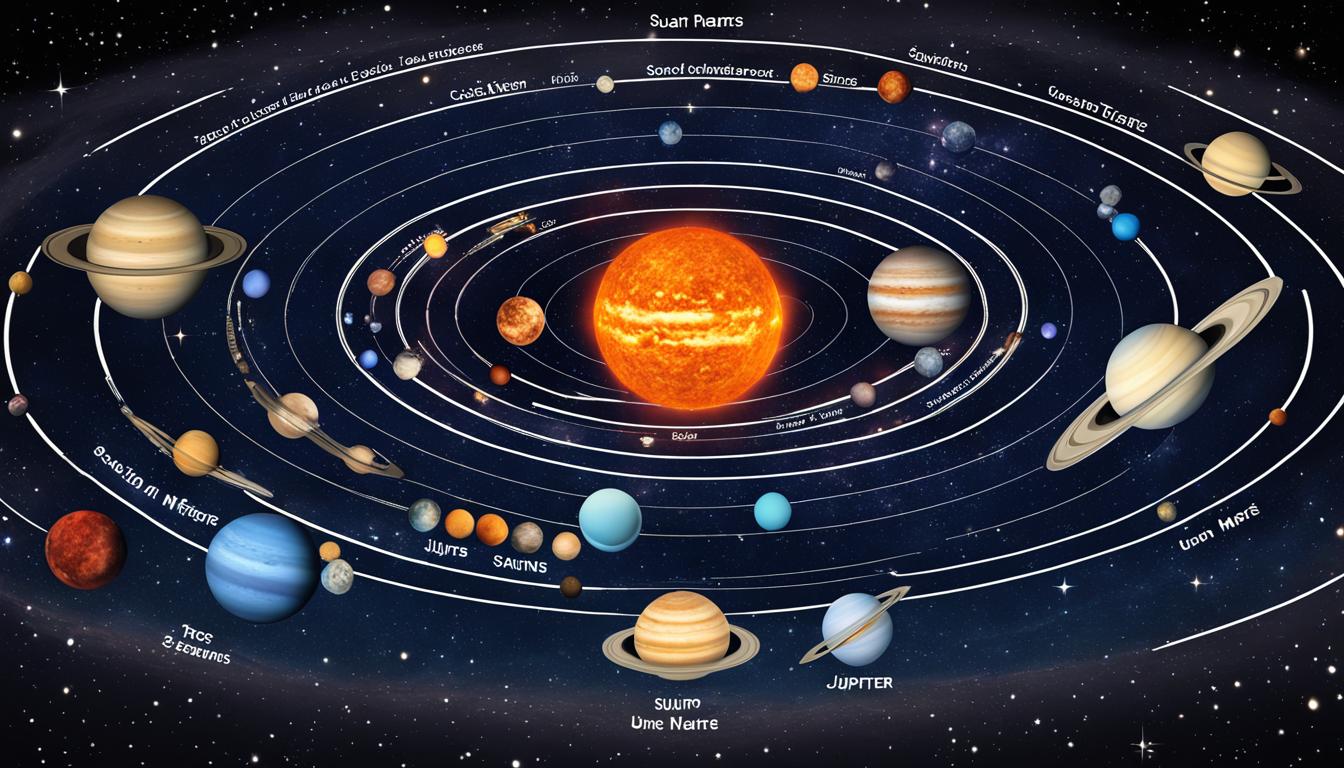
Get ready for an exciting trip through our solar system! We’ll explore 10 cool facts that show how amazing it is. From the Sun’s changing looks to Pluto’s mystery and the hunt for new planets, there’s a lot to learn. Join us as we uncover the secrets of our cosmic neighborhood.
The Cosmic Chameleon: Our Sun’s Ever-Changing Appearance
Our Sun is the bright star at the center of our solar system. It changes and transforms often. The sunspot cycle is one way we see this change. It’s a cycle of more and less solar activity that takes about 11 years.
The Sunspot Cycle: A Mesmerizing Dance
Sunspots are dark spots on the Sun’s surface. They show the Sun’s strong magnetic activity. These spots change size and number over time, making a cycle.
At the cycle’s peak, the Sun has hundreds of these spots. During the quiet times, the Sun looks almost spotless.
Solar Flares: Brilliant Bursts of Energy
Solar flares are another amazing thing about the Sun. They are bright bursts of energy from the Sun’s surface. These flares can affect space weather and even our technology on Earth.
They are caused by the Sun’s magnetic field. Studying the Sun’s activity helps us understand space weather better.
Learning more about our Sun helps us appreciate its ever-changing nature. It’s a fascinating cosmic chameleon.
Fun Facts: The Largest and Smallest Planets in Our Solar System
Our solar system has a wide range of planets, each with its own special traits. Did you know Jupiter is more than 11 times bigger than Mercury? This shows how different our solar system’s sizes can be.
Jupiter, the huge gas giant, is about 142,984 kilometers wide. This makes it the biggest planet out there. On the other end, Mercury is only 4,879 kilometers wide, the smallest. This huge size difference shows how varied our solar system is.
Neptune is almost 4 times bigger than Mercury. Pluto, once thought to be a planet, is now a dwarf planet and is even smaller than Mercury, with a diameter of 2,374 kilometers. These size differences highlight the amazing variety in our solar system.
Mercury: The Smallest and Swiftest of Them All
Mercury is the smallest and fastest planet in our solar system. It’s often overlooked but has many secrets about our solar system. These secrets are about its makeup and how it works.
A Surprisingly Massive Core
Mercury is small but has a huge core. Scientists find this interesting because it tells us about how it was made and changed over time. The core is mostly iron and nickel, which helps us understand the early days of our solar system.
Looking into Mercury teaches us a lot about the universe. It’s the smallest and fastest planet, and it shows us how complex our solar system is.

Jupiter: The Colossal Gas Giant
Jupiter is a true marvel among the celestial bodies in our solar system. It is the largest planet, with a diameter over 11 times bigger than Earth’s. This gas giant’s size is awe-inspiring, making it much larger than the other gas planets.
Jupiter’s makeup is a mix of swirling clouds and turbulent weather patterns. The Great Red Spot, a huge storm bigger than Earth, shows how dynamic Jupiter’s atmosphere is. Studying this planet helps us understand the complex processes of the largest planet in our solar system.
The Asteroid Belt: A Cosmic Remnant
The asteroid belt sits between Mars and Jupiter. It’s a vast area filled with rocky objects from the early days of our solar system. These objects help us understand how our planets formed millions of years ago.
Fascinating Diversity Within the Belt
The asteroid belt is full of different celestial bodies. Most are asteroids, ranging from tiny to hundreds of kilometers wide. It also has dwarf planets like Ceres, Vesta, and Pallas. These objects tell us about the solar system’s early days and how it changed over time.
What makes the asteroid belt interesting is its variety. Some asteroids are light and crumbly, while others are heavy and solid. They’re made of different materials, including metals, rocks, and even ice. This mix of objects shows us what the early solar system was like.
Exploring the asteroid belt reveals more about its mysteries. It helps us learn about the past and could lead to new discoveries in space. This area is key to understanding how our solar system came to be and how it keeps changing.
Saturn’s Rings: A Celestial Masterpiece
The rings around Saturn are a wonder of our solar system. They have fascinated astronomers and the public for years. These rings are a sight to behold.
Composition and Origins of the Rings
Saturn’s rings are made mostly of ice and rock. They range from tiny grains to huge boulders. Scientists are still trying to figure out where they came from.
Some think they came from a moon that Saturn destroyed. Others believe they formed from small objects that stuck together over time.
Thanks to new research, we know more about Saturn’s rings. We see how gravity changes their look. Studying these rings can teach us about how our solar system was formed.

Pluto: The Demoted Dwarf Planet
Pluto was once seen as the ninth planet in our solar system. Now, it’s a dwarf planet, still fascinating astronomers and the public. The change in Pluto’s status has led to debates about what makes a planet and Pluto’s place in our solar system.
In 2006, the International Astronomical Union (IAU) decided to take Pluto down from being a planet. They said Pluto didn’t meet the criteria to be a true planet, like not having cleared its orbit of other objects. So, Pluto became a dwarf planet, a new type in the solar system.
Today, people still argue about Pluto’s status. Some think the decision was too quick and Pluto should be a planet again. Others believe the change was right to keep the solar system’s classification clear. Pluto’s small size and unique orbit make it interesting for astronomers and those studying planets.
The Oort Cloud: A Spherical Shroud of Comets
At the edge of our solar system, there’s a huge, icy area called the Oort Cloud. It’s thought to be where many long-period comets come from. These comets take thousands of years to go around the Sun, making them a wonder for those who love the stars.
The Kuiper Belt: A Cosmic Treasure Trove
Nearer the Sun, but still past Neptune’s orbit, is the Kuiper Belt. It’s full of icy bodies and dwarf planets like Pluto. This area is a treasure chest of information about our solar system’s beginnings and changes. By studying the Kuiper Belt, scientists learn more about our solar system’s edges and what it’s made of.
The Oort Cloud and the Kuiper Belt are full of mysteries. Astronomers are still learning about them. Their studies help us understand where our solar system came from and how it works. This is exciting for scientists and the public alike.
The Quest for Habitable Exoplanets
The search for habitable exoplanets is a thrilling area of research. NASA’s Kepler mission and other advanced telescopes have found thousands of exoplanets. This opens up new chances to find Earth-like worlds that might support life.
Scientists are driven by a deep curiosity and a desire to know our place in the universe. They’re looking for planets like Earth where life could start. Astrobiologists and space fans are excited about this search.
Scientists use advanced tools and models to study these distant worlds. They aim to learn about their atmospheres, surfaces, and if they could support life. The dream is to find a planet like Earth that we can study closely. This could help us understand how life began elsewhere in the universe.