
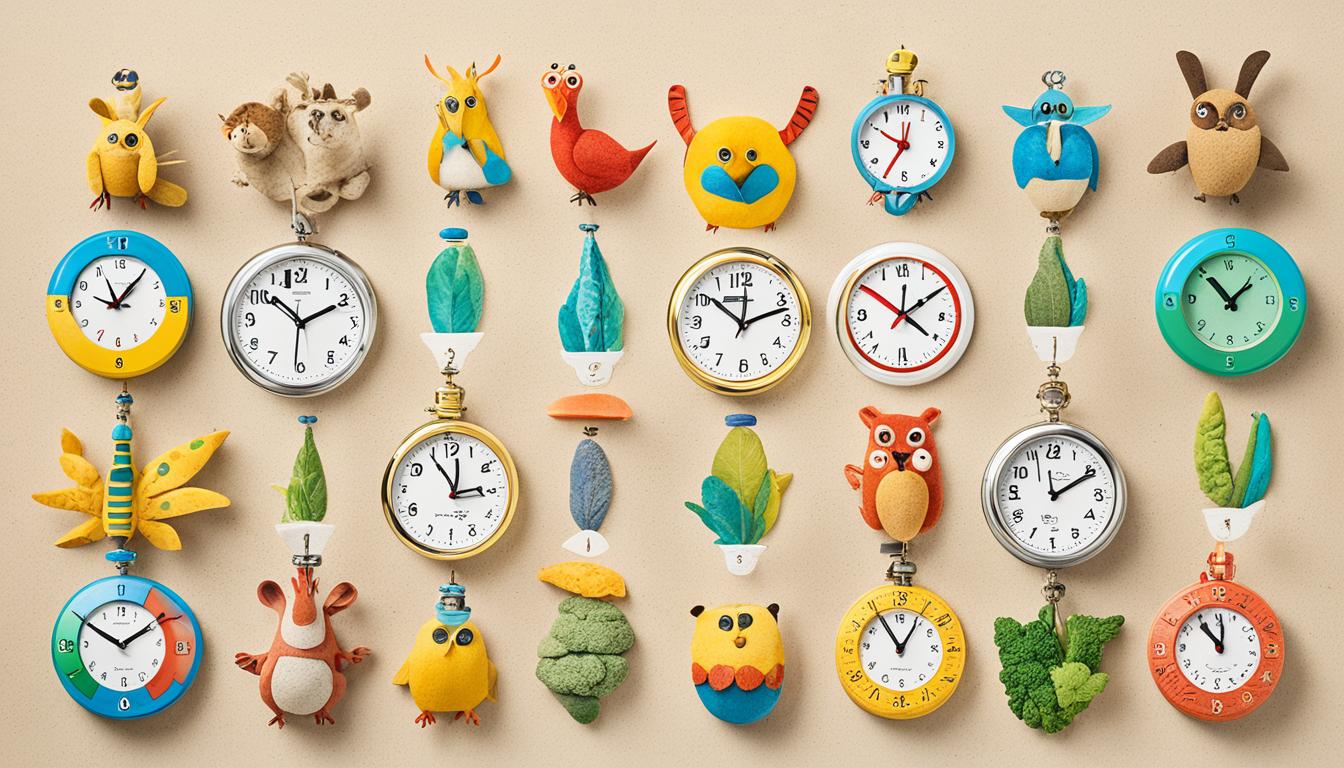
Time is a mystery that has captured human interest for centuries. It’s more than just the passing hours and days. There’s a world of strange and thought-provoking time phenomena that challenge how we see reality. Get ready for 10 unusual facts about time that will make you question everything.
This article will explore the mysteries of time, from how we perceive it to the idea of time travel. You’ll discover the enigmas and hidden truths of time. These facts will show you the extraordinary beyond our usual understanding.
If you’re curious or love the unusual, these facts will amaze you. They’ll broaden your view of time and change how you see the universe. Prepare to have your mind expanded.
Time’s Elusive Nature
Time has always been a mystery that has caught the attention of many. Philosophers, scientists, and thinkers have explored its subjective nature and relativity of time experience. Our experience of time changes a lot because of different factors.
Exploring the Enigma of Time
Time is seen as a construct, a way we measure and organize our lives. But the time paradox shows us that time isn’t just a simple concept. It’s more like a feeling shaped by our minds and the world around us.
Albert Einstein’s theory of relativity makes time even more complex. He said that how fast time goes by depends on how fast you’re moving and where you are in gravity. This idea makes us question what we thought we knew about time and reality.
Trying to understand time shows us how much it’s shaped by our own experiences and beliefs. The mystery of time keeps us curious and pushes us to learn more about ourselves and the world.
Unusual Time Zones
Across the globe, there are several strange time zones that don’t follow the usual hour system. They challenge how we think about time. Countries and regions have unique time regions and temporal anomalies. This shows the world’s wide variety of unconventional timekeeping practices.
Nepal is a great example with a time zone 15 minutes off from its neighbors. This creates a temporal anomaly that can confuse travelers. Kiribati, an island nation, is another example. It’s a day ahead of its neighbors because it crosses the International Date Line.
Some places keep time in their own way, not following national or regional time zones. This unconventional timekeeping reflects their culture, isolation, or how they view time. It shows how time can be seen differently around the world.
These strange time zones and unique time regions remind us that time is complex and flexible. It’s seen and kept in many ways globally.
Time Travels Through Wormholes
Wormholes have always sparked the interest of scientists and fans of science fiction. They are thought to be tunnels through space-time that could connect far-off parts of the universe. This idea makes us wonder if we could travel through time using them.
The Science Behind Wormholes
Wormholes are like tunnels in space-time, according to theory. If they exist, they could let us travel through time and space. Scientists think that these tunnels could change how we see time.
There’s a lot of debate about if wormholes really exist. But thinking about them has led to new ideas in science. The idea of using wormholes to move through space and time is still a big dream for scientists.
Unusual Clocks and Timekeeping
There’s more to timekeeping than just mechanical and digital clocks. The world is full of unusual and unique devices. These quirky clocks and innovative methods offer a fresh take on tracking time.
Unconventional Timekeeping Methods
The Astrarium is a clock that shows the position of stars and planets instead of hours and minutes. It uses the movement of celestial bodies to tell time. This gives us a new way to see how time passes.
Sundials and water clocks have been around for centuries. They track the day in a natural way. These methods offer a unique approach to timekeeping.
The Flower Clock uses flower petals to show the time. It’s a clock that’s also a piece of art. It combines nature with the need to measure time.
Unusual timepieces and innovative devices give us new ways to think about time. They offer a fresh and thought-provoking view of how we experience time.
The Unusual Concept of Time Travel
The idea of time travel has always caught our attention, mixing science and science fiction. It challenges our view of the universe with its theories and paradoxes. This concept has been intriguing for centuries.
Scientists look into quantum mechanics and time to see if time travel is possible. They talk about wormholes and changing spacetime. These ideas make us think about moving beyond our usual time limits.
But, time travel brings up big problems, like how it affects cause and effect. These paradoxes make us question the logic of time travel. Despite these challenges, it remains a captivating topic for scientists and fans of sci-fi.
Time travel makes us think differently about the universe and brings up deep questions. It’s a complex and fascinating topic that keeps us curious. As we learn more about physics and time, the idea of time travel stays intriguing.
Unusual Time-Related Phenomena
There are many reported cases of strange time-related events that have puzzled scientists and the public. These events challenge our understanding of time and how we experience it. They make us question the flow of time and its nature.
Temporal Glitches and Time Distortion Experiences
People from all over the world have shared stories of time seeming to slow down, speed up, or even stop. These moments leave them feeling confused. They don’t fit with our usual idea of time moving in a straight line.
Scientists have looked into these strange time events. They’ve considered many factors, like our brains, the environment, and even tiny quantum changes. But, they still don’t fully understand why these things happen. These mysteries keep us guessing and make us think differently about time.
Unusual Time Measurements
Most of us use seconds, minutes, and hours to tell time. But, there are many other ways to measure time that are interesting. These include ancient methods and new ideas that show how complex time can be.

In the 1990s, the Swiss watchmaker Swatch introduced Swatch Internet Time. It split the day into 1,000 “beats,” each lasting 1.44 minutes. This idea aimed to go beyond traditional time zones and schedules.
Another system, the Decimal Time, was used in France during the French Revolution. It divided the day into 10 hours. Each hour had 100 minutes and 100 seconds. This system offered a fresh way to see how time passes.
Looking back, ancient cultures like the Mayans and Aztecs had their own time-keeping systems. They used astronomy and deep beliefs to measure time. These systems were based on the cycles of the stars and planets. They show us different ways to understand time beyond our usual view.
The Unusual Impact of Time on Health
Time has a deep and often surprising effect on our health and well-being. Exploring chronobiology reveals how time and our biology are closely linked. This shows how our internal clocks affect our health, both physically and mentally.
Circadian rhythms are key to this link. They are our natural 24-hour cycles that control many body functions. These rhythms help manage our sleep, hormone levels, body temperature, and immune system. If these rhythms get out of sync, it can lead to sleep problems and other health issues.
Time also affects how well medical treatments work and when diseases start or get worse. This shows why understanding chronobiology is crucial in healthcare. Doctors can then tailor treatments better to help patients recover faster.
As we learn more about time and our biology, chronobiology is giving us new insights. These insights help us understand and improve our health. By knowing how time affects us, we can live in harmony with our natural rhythms. This can make us healthier and more energetic.
Unusual Cultural Perspectives on Time
Time isn’t the same everywhere. Different cultures have their own unique views on time. These views are seen in their stories, traditions, and beliefs about time. They often go beyond the Western idea of time as a straight line.
Time in Folklore and Traditions
In some cultures, time is seen as a circle, with events happening over and over. This idea is found in the folklore of time in many indigenous communities. Stories and legends show how time is viewed and valued in these cultures.
For example, the Dreamtime of Aboriginal Australians and the cyclical time of ancient Mesoamericans show different ways to see time. These temporal beliefs give us a glimpse into how time is understood across the globe.
These views challenge the idea of time as a straight line from past to future. Instead, they see time as more flexible and even supernatural. Looking into these unusual time perspectives helps us see how people have thought about time throughout history.
Unusual Sayings and Idioms About Time
The English language is full of quirky phrases and metaphors about time. These sayings show how complex our relationship with time is. From “time flies when you’re having fun” to “a stitch in time saves nine,” they give us a peek into how we see and experience time.
“A watched pot never boils” tells us that our waiting can make time seem longer. “The eleventh hour” makes us think of urgency and doing things at the last minute. These phrases make our language more colorful and show how tricky time can be.
Looking deeper, we find metaphors that make time seem like something we can control or lose. “Killing time” and “time slipping away” treat time like a thing we can play with. “Time standing still” makes it seem like time has stopped. These sayings show how we try to make time human, wanting to control it.
The many idioms and metaphors about time in English show how much we’re fascinated by it. They let us see the different ways we see, feel, and deal with time. These expressions are like special tools that help us understand time better.

Unusual Time Management Techniques
In today’s fast-paced world, traditional time management doesn’t always cut it. But there are many unusual methods that can change how we organize our days and increase productivity. Techniques like the Pomodoro Technique and timeboxing offer fresh ways to work and live.
The “time-blocking” method is one such strategy. It divides the day into set times for specific tasks. This helps reduce distractions and makes time use more focused and intentional. Timeboxing is similar but sets strict time limits for tasks, creating a sense of urgency and promoting efficiency.
Then there’s “body-doubling,” a method that involves working with a partner or group. It boosts accountability and motivation. This approach is great for those who struggle with staying on track or find solo work hard.