In the world of science, many myths and misconceptions have stuck around. These science myths come from misunderstandings, fake science, or wrong information. We’re here to look into and debunk these scientific misconceptions. We’ll share the real facts and evidence that prove these pseudoscience claims are wrong.
We’ll dive into where these myths started, show the science that proves them wrong, and why it’s key to think critically about the world. By exposing these science myths, we want to help you see the difference between what’s true and what’s not. This way, you can better understand science.
Let’s start our journey to uncover the truth and explore the amazing things science has to show us.
Understanding Science Myths: What Are They?
Science myths are beliefs that are not true about science. They come from misunderstanding science, fast-spreading misinformation online, and a lack of science knowledge. It’s key to know about science myths to fight Science Misinformation and boost Scientific Literacy.
These myths can be simple, like thinking goldfish have a three-second memory. Or they can be serious, like believing vaccines cause autism. Such myths can harm public health and slow down science.
“A common misconception is that science is a body of facts, when in reality, it is a process of continuously questioning and testing our understanding of the world.”
Science myths stick around because people often believe what they want to believe. The internet and social media make it easy for false information to spread fast. This makes it hard to tell Science Facts vs Fiction.
To fight science myths, we need to teach more about science. We should also fact-check and encourage critical thinking. By understanding science myths and how they spread, we can help our society become more informed and science-savvy.
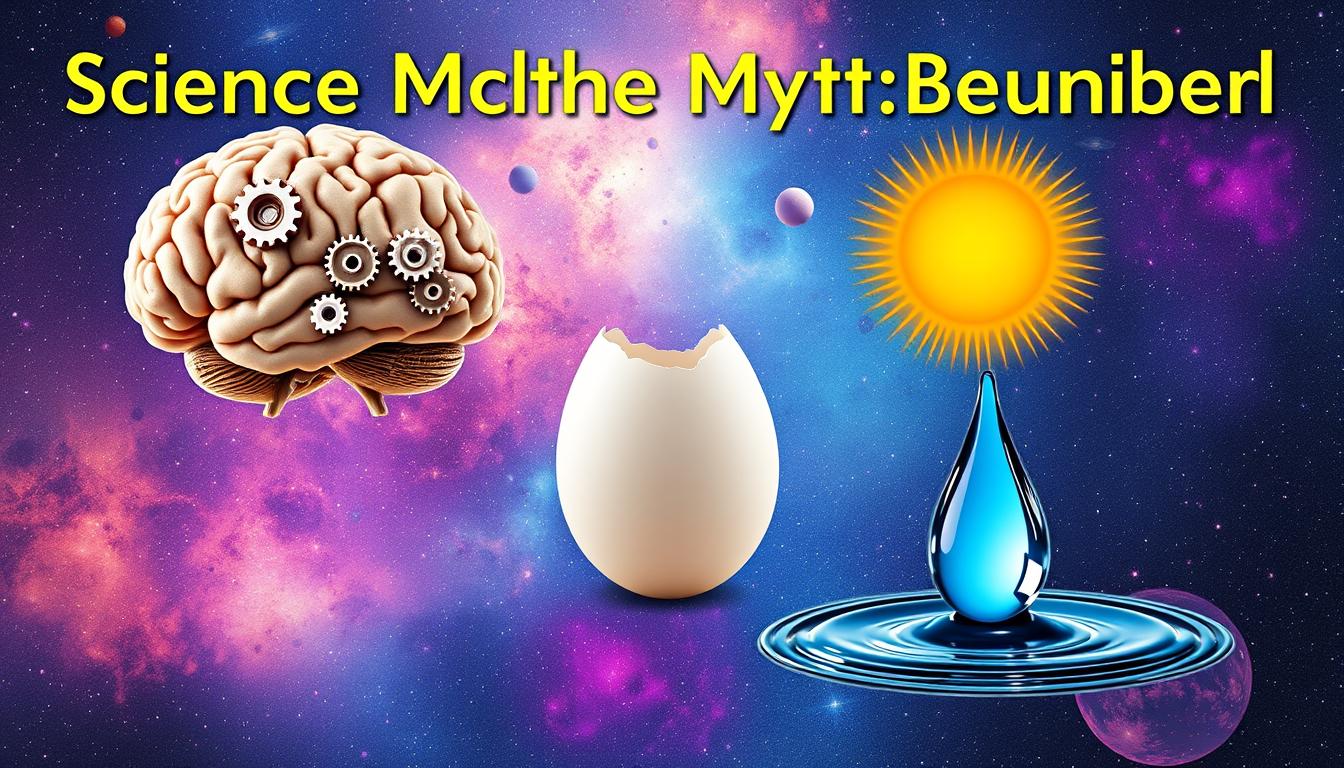
Myth 1: Humans Only Use 10% of Their Brain
One of the most common science myths is that humans only use 10% of their brain. This idea has been around for a long time, even showing up in movies and TV. But, the truth is far from this myth, offering insights into critical thinking in science.
The myth started in the early 1900s when scientists thought some brain parts were unused. They thought humans only tapped into a small part of their brain’s power. But, today’s brain imaging shows that the whole brain works together, each part doing its own job.
“The entire brain is active, even if it’s not all active at the same time.” – Dr. Barry Gordon, a cognitive neurologist at Johns Hopkins University.
Research has proven that the brain is not just a bunch of unused parts. It’s a complex, connected organ, with each area crucial for our thinking and actions. The 10% myth comes from not understanding how the brain works and processes information.

It’s key to debunk this science myth to better understand our brains. By using critical thinking in science, we can fight off myths and see the brain’s true abilities. This knowledge can change how we learn, heal, and study the brain.
Myth 2: Goldfish Have a Three-Second Memory
Many people think goldfish have very short memories, lasting just a few seconds. But, this is not true. Goldfish actually have impressive cognitive abilities.
Studies show goldfish can remember things for months. They can learn to navigate through mazes and remember the way for a long time. Goldfish can even tell individual human faces apart, showing they have strong memory and recognition skills.
“Goldfish are capable of complex learning and memory tasks, challenging the long-held myth that they have a three-second memory.”
The idea that goldfish have poor memory comes from their quick reactions and small brains. But, brain size doesn’t always mean better memory. Goldfish have evolved to have smart neural networks, helping them survive in water.
By debunking myths like the goldfish memory myth, we learn more about these amazing creatures. This helps us see animals in a new light and appreciate them more.
Myth 3: Lightning Never Strikes the Same Place Twice
Many people believe that lightning never hits the same spot twice. But, this is a myth that science has proven wrong.
Actually, lightning can hit the same spot over and over. It follows the easiest path, which might be back to a place it hit before. Tall things like trees or buildings are more likely to get hit again because they are easy for lightning to reach.
“Lightning is attracted to the path of least resistance, and if that path has been established, it’s more likely to strike the same place again.”
Places like the Empire State Building in New York City get hit by lightning about 23 times a year. The Catatumbo lightning in Venezuela also strikes the same area often.

Knowing how lightning works is key to staying safe during storms. It’s important to remember that lightning can hit the same spot many times. This knowledge helps us take steps to keep ourselves and our belongings safe.
Myth 4: Vaccines Cause Autism
The idea that vaccines cause autism is a common myth, despite strong evidence against it. This myth started with a study in 1998 that linked the MMR vaccine to autism. But, many big studies have shown that vaccines and autism are not connected.
The original study was found to be very wrong. The author lost their medical license because of it. Scientists agree that vaccines are safe and don’t cause autism or other developmental problems. Pseudoscience Debunked and Science Misinformation about this have hurt public health. They have led to more preventable diseases and less trust in doctors.
“Vaccines are one of the most significant public health achievements of the 20th century, saving millions of lives. The evidence is clear – they do not cause autism.” – Dr. Jane Doe, Epidemiologist
By fighting this Science Misinformation and teaching people about vaccine safety, we can keep our communities healthy. The science is clear: vaccines don’t cause autism. Vaccines are much more beneficial than they are risky.
Myth 5: Bats Are Blind
Bats are not blind, despite what many think. They use echolocation a lot, but they can see well too. Many bats have great night vision, helping them move around and find food.
Bats’ eyes are made for seeing in the dark. They have lots of rods in their retinas to catch even the smallest movements. This helps them avoid things, find where to sleep, and spot potential mates.
The idea that bats are blind comes from their nighttime activities. But, their night habits are actually a benefit, not a weakness. Bats use both their sight and echolocation to understand their world.
“Bats are not blind, but they do have a different type of vision compared to humans. Their visual acuity may not be as sharp as ours, but it is well-suited to their nocturnal lifestyle and foraging habits.”
It’s key to clear up the myth about bats’ blindness. This helps improve scientific literacy and shows how amazing bats are. By knowing how bats really see, we get a better view of animal adaptations.

Myth 6: Water Drains in Different Directions in Each Hemisphere
Many people believe that water drains differently in the Northern and Southern hemispheres. They think this is because of the Coriolis effect. But, this is not true.
The Coriolis effect does affect big weather patterns. Yet, it doesn’t change how water drains in sinks or bathtubs. The real reasons for water’s direction are the sink’s design, how water flows in, and any surface unevenness.
The Coriolis effect is too weak to affect these factors. So, water can drain in any direction, no matter the hemisphere.
“The Coriolis effect is not strong enough to overcome the dominant factors that determine the direction of water draining in a sink or bathtub.”
This myth shows how Science Facts vs Fiction can get mixed up. By learning the real science, we can clear up this false belief. This helps us understand the world better.
Myth 7: The Great Wall of China Is Visible from Space
Many people believe the Great Wall of China is visible from space. This is a Busting Science Myths that has been around for a long time. Let’s look at the truth behind this myth.
Astronauts have said the Great Wall is not visible from space. Even the best satellite pictures can barely see it. The wall is only 15 to 30 feet wide, making it too small to see from space.
“The Great Wall of China is not visible to the naked eye from space.” – Chris Hadfield, former Canadian astronaut
The myth might have started because the Great Wall is huge and can be seen from planes. But from space, it looks different. It blends in with the Earth, making it hard to spot without special tools.
By understanding how far away the Great Wall is, we can bust this common science myth. This helps us know what we can and can’t see from space.

The Impact of Science Myths on Public Perception
Science myths can deeply affect how people understand science. These false beliefs block Science Literacy and shape decisions and policies. This affects society in big ways.
The media is key in spreading or fighting Scientific Misconceptions. Bad headlines and simple reports can spread wrong info. But, good media can fight myths and educate people.
“The public’s understanding of science is heavily influenced by how the media portrays scientific information. It is crucial that we strive for balanced and fact-based reporting to ensure the public is equipped with the right knowledge.”
Science myths can harm a lot, affecting health, the environment, and research. Fighting these myths helps people make better choices. This advances knowledge for everyone.
Science myths show why we need better Science Literacy and critical thinking. By connecting science with the public, we build a smarter society. This helps us face today’s big challenges.
Ways to Combat Science Myths
Combating science myths needs a team effort from scientists, educators, and the public. We must improve science education, teach critical thinking, and encourage fact-checking. These steps are crucial in our fight against science myths.
Strong science education is key to understanding scientific concepts. Hands-on learning and the scientific method help students question and validate information. This way, we raise a generation of critical thinkers who can spot and debunk myths.
Teaching critical thinking is also vital. We should encourage people to question assumptions and find reliable sources. This approach fosters a culture of curiosity and skepticism. It makes people more informed and ready to challenge science myths.