
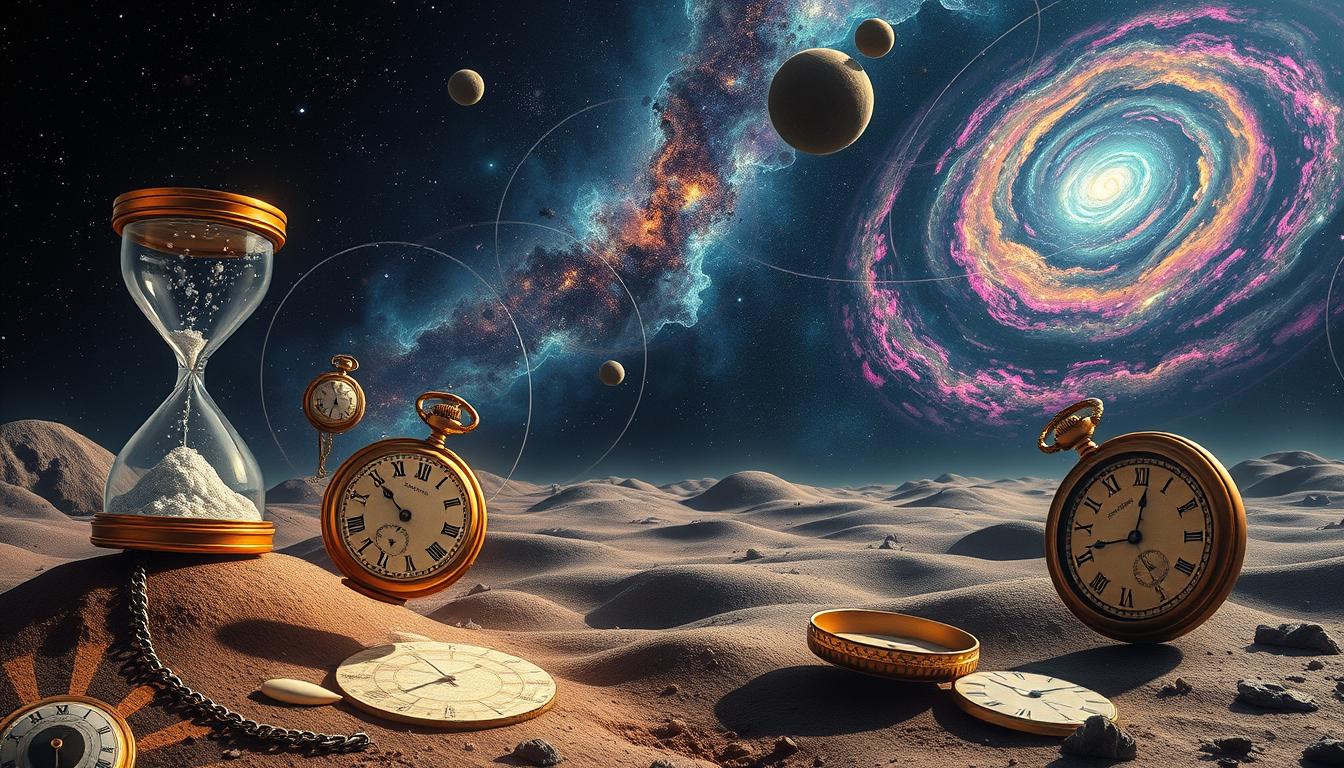
Time is a fascinating and mysterious concept that has intrigued many for centuries. From ancient Egyptians to modern physicists, our way of seeing and measuring time has changed a lot. In this introduction, we’ll look at some of the most interesting and strange facts about time and how we measure it.
Did you know the length of a second has changed over time? At first, a second was based on the Earth’s rotation. But as we learned more about the universe, we updated its definition. Now, a second is based on an atomic clock’s vibrations, which can measure time very accurately.
Another interesting fact is that time can be affected by how fast an object moves. Einstein’s theory of relativity says time goes slower for fast-moving objects. This means astronauts on the International Space Station experience time a bit differently than us on Earth. Time dilation has been a big idea in science fiction for years, exciting many readers and viewers.
As we explore time’s mysteries, we’ll find a mix of cultural views, scientific ideas, and tech advancements. These have all helped us understand time better. Join us on this journey to discover the strange and fascinating world of time and time measurement.
The Concept of Time Travel in Science Fiction
Time travel has always fascinated us, and science fiction leads the way in exploring it. Classics like “The Time Machine” by H.G. Wells and “Back to the Future” have made time travel a key part of the genre. They shape how we think about time travel’s possibilities and challenges.
Science fiction writers have come up with creative time machines and explored what happens when we change the past or see the future. For example, “A Sound of Thunder” by Ray Bradbury shows how small changes in the past can affect us today.
“The future is already here – it’s just not very evenly distributed.” – William Gibson
Science fiction has greatly influenced how we see time travel. Movies, TV shows, and books have made time machines a staple of popular culture. They entertain us and also spark scientific discussions, showing us what might be possible.
As we learn more about time and space, science fiction’s ideas might become real. Until then, it keeps our imagination alive and makes us think deeply about time travel.
Historical Perspectives on Time Measurement
For centuries, humans have been fascinated by time. From the first ancient sundials to today’s temporal mechanics, our journey in time measurement is filled with innovation. It shows how far we’ve come in understanding time.
In ancient times, people used the sun to tell time. Sundials were simple but effective. They helped our ancestors keep track of the day’s hours. These tools were not just useful; they also connected us to nature’s cycles.
“Time is the most valuable thing a man can spend.” – Theophrastus
As societies grew, so did our way of measuring time. Mechanical clocks in the Middle Ages changed everything. They brought us precise, standard time. This led to big advances in science, navigation, and daily life.

Now, temporal mechanics has reached incredible levels. Atomic clocks can measure time with unmatched accuracy. These technologies are key to understanding the universe. They help us study relativity and explore space.
The Science Behind Time Travel Theories
Time travel has always fascinated people. Modern science has found interesting facts about it. Albert Einstein’s work on relativity is key to these theories.
Einstein showed that time isn’t always the same. It changes with speed and gravity. This means time can slow down for fast-moving objects or those in strong gravity fields. This idea is important for time travel, as it could let us travel into the future.
Wormholes are another interesting idea in time travel. They are like shortcuts through space-time. Some scientists think wormholes could be used to travel through time. But, whether wormholes really exist is still debated.
“The distinction between the past, present, and future is only a stubbornly persistent illusion.” – Albert Einstein
Time travel science is complex and still being studied. Yet, many people find it fascinating. As we learn more about space and time, traveling through time might become possible.
How Time Zones Became a Necessity
The world became more connected, making a standard time system crucial. This was key for global trade, travel, and talks. The International Date Line was a major step in this process.
The International Date Line is an imaginary line from the North Pole to the South Pole. It was made to solve timekeeping issues over long distances. Ships and trains crossing the globe faced problems with time differences. The line helped make timekeeping smooth worldwide.

Time zones were also a big step. They divided the world into areas with the same time. This helped businesses and people work together better. It was vital for banking, transport, and telecom, where working together across time zones was key.
Now, time standardization and the International Date Line are key to our global world. With technology making the world smaller, these systems are more important. They help us deal with our 24-hour, worldwide life.
Unique Ways Cultures Measure Time
Time is a universal concept, but cultures measure it in many ways. Western societies use the Gregorian calendar and 24-hour clock. But, many traditional societies have their own cultural time perception systems. These systems reflect their values, beliefs, and life rhythms.
The Balinese calendar is based on lunar and solar cycles. Each day is linked to specific elements, colors, and deities. The ancient Mayans also had a complex traditional calendars system. It included a 260-day ritual calendar and a 365-day solar calendar.
“Time is not something that can be measured with clocks and calendars alone. It is a reflection of our cultural and spiritual beliefs, as well as the natural cycles of our environment.”
In many indigenous cultures, time is tied to nature’s cycles. For example, the Inuit people of the Arctic use the sun’s position and animal appearances to keep time. This shows how different cultures view time in unique ways.
Exploring these cultural time perception systems helps us understand different societies’ views on time. It broadens our view of the human experience. It also highlights the richness and complexity of the world’s cultural heritage.
The Impact of Time Travel on Popular Culture
Time travel has always fascinated writers, filmmakers, and fans. It has shaped popular culture, from old science fiction to today’s big movies. These stories of time travel have not only entertained but also made us think about time.
Time travel movies have had a big impact. Films like “Back to the Future,” “Looper,” and “Interstellar” have drawn in viewers. They show the risks and wonders of time travel, making us think about cause and effect.
“The past is not dead. It is not even past.” – William Faulkner
Time travel stories aren’t just in movies. They’re also in books, TV shows, and games. These stories make us question time and cause and effect. They show our deep interest in time and what’s possible.

Time travel stories do more than entertain. They also inspire science. Scientists look into time travel theories and exotic phenomena. This mix of science fiction and science has changed how we see the universe and our role in it.
Time Paradoxes: What They Mean for Travelers
Time travel fascinates us, leading to mind-bending paradoxes. The grandfather paradox and bootstrap paradox challenge our view of time. The grandfather paradox asks: what if a time traveler stops their own grandfather from meeting their grandmother? The bootstrap paradox suggests a loop where a time traveler brings back information that was theirs all along.
These paradoxes make us question time and retrocausality. If time travel is possible, could it mess with our causal order? Or might understanding physics and time solve these puzzles?
“Time travel may seem like the stuff of science fiction, but the philosophical and scientific implications of these paradoxes are very real. They challenge our most fundamental assumptions about causality and the arrow of time.”
Exploring time travel, we’ll keep learning about the universe and our role in it. The journey will be thrilling and thought-provoking, as we explore time’s mysteries.
Modern Tools for Measuring Time Accurately
We’ve made huge strides in timekeeping since sundials and hourglasses. Now, we use atomic clocks and quantum timekeeping to measure time with great accuracy.
Atomic clocks are key in navigation, communication, and science. They use atoms’ natural vibrations for a steady time reference. These clocks lose only a second every million years.
“Atomic clocks are the most accurate time-keeping devices in the world, accurate to within a few billionths of a second per day.”
Quantum timekeeping is the next big thing. It uses quantum mechanics for even more precise timekeeping. Quantum clocks could measure time with even greater accuracy.
These tools are vital in our daily lives. They help sync global networks and guide our navigation systems. As we explore new ways to measure time, the future looks bright.
The Connection Between Time and Space
In modern physics, the link between time and space is fascinating. Albert Einstein’s theory of relativity introduced the spacetime continuum. This idea has changed how we see the universe.
The core of this bond is time dilation in space travel. When people move fast or near big objects, time seems to slow down for them. This is because of the way spacetime curves, as Einstein showed.
“Time is not absolute; it is relative to the observer’s motion.” – Albert Einstein
This idea has big effects, from space travel to how we see reality. Astronauts on long missions age less than those on Earth. This is because time moves slower for them.
Exploring space further means understanding time and space better. The spacetime continuum is a vast area we’re still discovering. It holds secrets about our existence and the universe.
Philosophical Questions About Time
Time has always been a big topic in philosophy. People have wondered about time’s linearity and free will. These questions have led to interesting debates among thinkers for centuries.
One big debate is about time’s linearity. Is time just a straight line, or is it more complex? Some think time could have loops or parallel paths, making it not just one-way.
“Time is an illusion, lunchtime doubly so.” – Douglas Adams
Another important topic is free will. If time goes in one direction and is set, can we really choose what happens? Philosophers try to figure out how our choices fit into the timeline.
Also, how does time relate to our minds? Does our view of time shape our reality, or does reality shape our view of time? The nature of time and its link to our minds are big questions in philosophy.

Fun Time Travel Trivia to Impress Friends
Time has always fascinated us. From time travel facts to temporal curiosities, there’s plenty to share. Let’s explore some interesting facts about time and how we measure it.
Did you know time zones started in the 19th century? They helped coordinate train schedules. Before, each town had its own time, making travel hard. Time zones changed everything, allowing clocks to sync across the world.
“Time is an illusion. Lunchtime doubly so.” – Douglas Adams, The Hitchhiker’s Guide to the Galaxy
The ancient Egyptians were the first to divide the day into 24 hours. They watched the sun and stars to do this. Their idea of a 24-hour day still holds today, even with all our tech advances.
Leap years and time travel theories make time a fascinating topic. Whether you love science or just fun facts, there’s always something new. Time is a treasure trove of Time Travel Trivia.
The Future of Time Travel: Possibilities and Challenges
Scientists are making big strides in time travel research. They’re using quantum physics and general relativity to explore new ideas. These advancements could make time travel a reality, but there are big challenges ahead.
NASA’s Breakthrough Propulsion Physics Program is leading the way. Physicists like Michio Kaku and Kip Thorne are also making important contributions. They’re looking into wormholes and how to control spacetime, which could enable time travel.
But time travel raises big questions. There are worries about changing the past and disrupting the timeline. These concerns are sparking debates among scientists and policymakers. Figuring out how to handle these issues is key to moving forward in time travel research.