In the early 20th century, Albert Einstein changed how we see the universe. His theory of relativity challenged the old views of space and time. He showed that they are connected in a four-dimensional space called “space-time.”
Einstein’s work changed how we see the world. It also opened new paths in physics and quantum mechanics.
Einstein’s key idea was that the speed of light is always the same. This idea makes us think differently about time and space. He showed that time and distance can change based on how fast we move and where we are.
Einstein’s theory has led to many new discoveries. It has helped us understand black holes and quantum mechanics. His work has inspired many scientists to explore and discover more about our universe.
What is Space-Time?
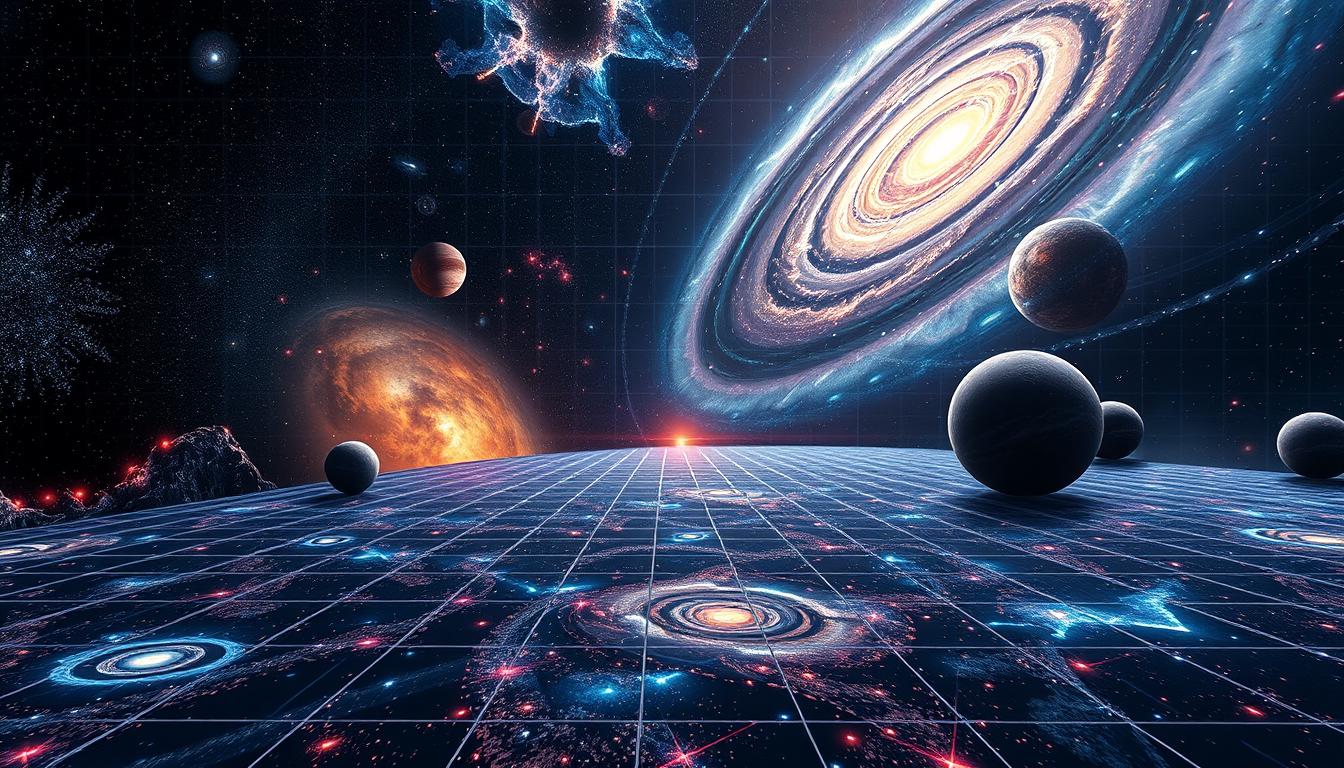
Space-time is a key part of Einstein’s theory of relativity. It changed how we see the universe. It combines the three dimensions we know – length, width, and height – with time. This makes a single, four-dimensional fabric called the Spacetime Continuum.
This fabric is like a huge, flexible canvas. It holds all the things in the universe, like planets and stars. When these objects move, they warp the fabric of space-time, much like a heavy object on a sheet.
“Space-time is not something separate from the material world, but is intricately woven into its very fabric, so that the properties of space and time are determined by the distribution and motion of matter and energy in the universe.”
Understanding space-time is key to grasping the universe’s complexity. It helps us see how the cosmos works and changes. By studying this fabric, scientists can learn about gravity and the universe’s beginnings.
The Origins of the Theory of Relativity
The roots of Einstein’s groundbreaking theory of relativity go back to the late 19th and early 20th centuries. The Michelson-Morley experiment in 1887 was key. It aimed to find the luminiferous ether, thought to be in space and carry light. But, it found nothing, shaking up old ideas.
Other scientists like Henri Poincaré and Hendrik Lorentz also played a big role. Their work helped Einstein create his special theory of relativity in 1905. This changed how we see space, time, and the universe. It showed that light always travels at the same speed, leading to more discoveries.
“The most beautiful thing we can experience is the mysterious. It is the source of all true art and all science. He to whom this emotion is a stranger, who can no longer pause to wonder and stand rapt in awe, is as good as dead: his eyes are closed.”
– Albert Einstein
In 1915, Einstein’s general theory of relativity came out. It showed gravity warps space-time. This idea has led to understanding Black Holes and Cosmic Inflation, which shaped the early universe.

The theory of relativity started with past scientific breakthroughs. It has led to our current understanding of the universe and its forces. This journey of discovery still excites and inspires scientists today, as they explore the universe’s secrets.
The Two Pillars of Relativity
Einstein’s theory of relativity is built on two key parts: special relativity and general relativity. These parts work together to help us understand space and time.
Special relativity, introduced in 1905, changed how we see the universe. It showed that time and space are not fixed but can change. This idea helped us grasp wormholes and singularities, which are strange parts of our universe.
“Space and time are not absolute, but relative to the observer’s frame of reference.”
General relativity, introduced a decade later, added gravity to the mix. It says gravity is not a force but a result of space-time’s curve. This curve is caused by big objects, which bend the universe. General relativity led to big discoveries like black holes and gravitational waves.

Together, special and general relativity are the bases of our modern view of the universe. They have changed how we see space, time, and the forces that shape the cosmos. They open doors to more exploration and discovery.
The Importance of the Speed of Light
In the world of Spacetime Curvature and Quantum Mechanics, the speed of light is key. It’s the fastest speed anything can move through space-time. This speed, called ‘c’, is a universal constant.
The speed of light is very important. It helps us understand the universe better. It shows us the limits of how things can move and how space and time are connected. Einstein’s famous equation, E=mc², shows how light speed is linked to mass and energy.
“The speed of light is the ultimate speed limit in the universe, and nothing with mass can ever reach it.”
The speed of light being constant has big effects. It causes time to slow down and things to appear shorter. These ideas, from Einstein’s theory, have been proven true. They change how we see space and time.
The speed of light is about 299,792,458 meters per second. It’s a key reference point for understanding the universe. Its role in physics is amazing and keeps us curious about the cosmos.

How Gravity Affects Space-Time
Think of space-time as a trampoline. Place a heavy object, like a bowling ball, on it. It creates a dent in the fabric, which we feel as gravity. Massive objects in our universe, like planets and stars, also warp the Spacetime Continuum around them. This affects the motion of nearby objects.
Einstein’s theory of Gravitational Waves says this warping is not a force. It’s just a result of the curvature. A marble on the trampoline will move along the depression made by the bowling ball. This is similar to how planets orbit around massive objects in space.
“Gravity is not a force, but a consequence of the curvature of space-time.”
This new view of gravity changes how we see the universe. It shows how Gravitational Waves are made, like when two black holes collide. These waves ripple space-time and can be detected by special observatories.

This new way of thinking about gravity has led to big discoveries. It helps us understand galaxy formation and black hole mysteries. The insights from the Spacetime Continuum have greatly changed our view of the universe.
Everyday Examples of Relativity
Albert Einstein’s groundbreaking theory, Relativity, has changed our world. It’s in our GPS systems and particle accelerators. These tools help us navigate and explore the universe.
The Global Positioning System (GPS) is a great example. It uses atomic clocks that are affected by Cosmic Inflation and gravity. Without these effects, GPS wouldn’t work, and we’d lose our way.
“Time dilation and length contraction, as described by Relativity, are not just theoretical concepts – they have very real and practical applications in our daily lives.”
Particle accelerators, like the Large Hadron Collider (LHC), also rely on Relativity. As particles get close to light speed, their mass grows. This helps scientists understand the universe’s smallest parts.
Relativity is everywhere in our modern world. It helps with global communication and measuring time and space. By seeing how it affects our lives, we can appreciate its impact and the mysteries it helps solve.
Common Misconceptions About Relativity
Einstein’s theory of relativity has changed how we see the universe. Yet, many people get it wrong. They think “everything is relative,” meaning no fixed truths exist. But, relativity just says the laws of physics are the same for everyone, no matter how fast they’re moving.
Some also believe relativity and quantum mechanics can’t work together. But, they’re not enemies. They cover different parts of our world. Scientists are working hard to merge them, studying things like Black Holes and Wormholes.
“Relativity is not about everything being relative, but rather about the relativity of certain physical quantities to the observer and the frame of reference.”
But, relativity has its limits. It doesn’t apply at the quantum level or in extreme places like Black Holes. Scientists are trying to make it work in these areas too.
By clearing up these myths, we can see how amazing Einstein’s work is. It’s still guiding us to understand the universe and reality itself.
The Impact of Relativity on Modern Science
Einstein’s Theory of Relativity has changed science forever. It has helped us understand the universe, from tiny particles to huge cosmic structures. This theory has led to many new discoveries and technologies that shape our world today.
Relativity has greatly influenced cosmology. It changed how we see space-time, helping us learn about the universe’s start, growth, and shape. Ideas like Singularities and Space-Time expansion are key to our Big Bang theory.
“Relativity not only transformed our understanding of the cosmos but also paved the way for revolutionary technologies that have transformed our daily lives.”
In astrophysics, relativity has been key in finding and studying black holes, neutron stars, and gravitational waves. These discoveries, predicted by the theory, have given us deep insights into gravity and matter under extreme conditions.
Also, relativity has shaped particle physics, helping us understand the fundamental forces and subatomic particles. The idea that mass and energy are equal (E=mc^2) has been crucial for nuclear power and medical imaging.
Relativity’s impact goes beyond science. It has inspired many technological advancements that change our lives, like GPS and modern communication systems. The precise understanding of Space-Time from relativity has been key to these innovations.
The Future of Space-Time Research
Scientists all over the world are still fascinated by space-time. They are trying to understand the basics of our universe. One big challenge is combining Einstein’s theory of relativity with quantum mechanics.
They are also studying how space-time curves and its connection to dark matter and dark energy. These mysterious forces are key to understanding the universe’s structure and growth. Researchers are working hard to figure out their role.
The dream of a unified theory of everything is still out of reach. This theory would connect the laws of physics for big and small things. As scientists explore more, they might make discoveries that change how we see the universe and our place in it.