
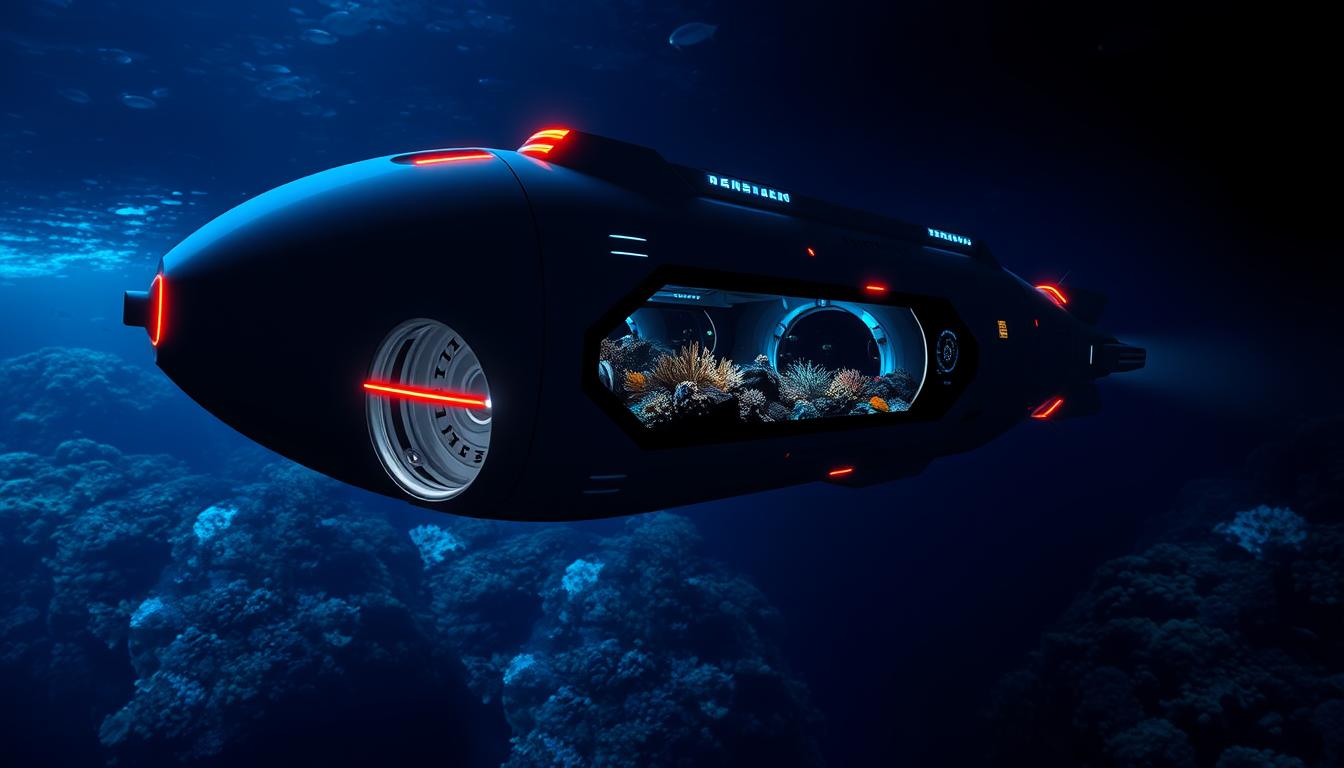
Our oceans are still a mystery, with much of the seafloor and the waters above unexplored. They hold secrets like undiscovered marine species and untapped resources. Exploring the ocean is key to protecting our ecosystems and securing a future for all.
Ocean Exploration, Marine Biology, and Underwater Robotics are crucial in understanding the sea. From vibrant coral reefs to the deep seafloor, our oceans are full of wonders. By exploring these areas, we learn about our planet’s balance and how human actions affect the ocean.
The Importance of Ocean Exploration
The ocean is vast and full of mysteries. It holds the secrets to understanding our planet and its balance. Oceanographic research is key to learning about deep-sea ecosystems and their role in climate and environment.
Exploring the ocean’s depths satisfies our curiosity and gives us scientific insights. We find new species and study how climate change affects marine life. Ocean exploration helps us grow our knowledge and find ways to live sustainably.
“The ocean is the lifeblood of our planet. Protecting its health is not just an environmental imperative, but a moral and economic necessity.” – Dr. Sylvia Earle, renowned oceanographer and explorer
The ocean also has huge economic potential. It offers chances for sustainable resources, renewable energy, and new technologies. By studying deep-sea ecosystems, we can find new ways to grow economically while keeping our oceans healthy.

As we explore more, understanding the ocean becomes even more crucial. Insights from ocean exploration are vital for fighting climate change and saving biodiversity. They help ensure a sustainable future for our planet and all living things.
Historical Overview of Ocean Exploration
For centuries, humans have been drawn to the mysteries of the oceans. From ancient voyages to today’s deep-sea missions, our history shows our endless curiosity. It highlights our drive to explore and learn more.
Explorers like Christopher Columbus and Ferdinand Magellan sailed into the unknown. They mapped coastlines and found new lands. In the 19th century, Maritime Archaeology began. It helped uncover shipwrecks and ruins, giving us a peek into the past.
“The sea, the great unifier, is man’s only hope. Now, as never before, the old phrase has a literal meaning: we are all in the same boat.”
– Jacques Cousteau, renowned French oceanographer and filmmaker
The 20th century saw a big leap in ocean exploration. New tech like Submersibles let scientists reach the ocean’s depths. They found the Titanic’s wreckage and discovered life in the deep.

Today, we’re still exploring the oceans with advanced tools. Research vessels, robots, and drones are leading the way. As we explore, we learn from the past. This helps us uncover the secrets of the deep.
Modern Technologies in Ocean Exploration
New technologies have changed how we explore the ocean. Advanced sonar, Autonomous Underwater Vehicles (AUVs), and Remotely Operated Vehicles (ROVs are key. They help us discover the secrets of the deep.
Underwater robots, like AUVs, are vital in ocean research. They can dive deep, gather data, and take pictures without a human. With sensors, they map the ocean floor, find underwater structures, and spot marine life. This has greatly improved our knowledge of ocean ecosystems.
“AUVs have opened up a whole new world of exploration, allowing us to venture into areas that were previously inaccessible or too dangerous for human divers.”
ROVs also play a big role in ocean research. These vehicles, controlled from the surface, can reach deeper parts of the ocean. They capture detailed images and videos, giving us new insights into the underwater world.

Advanced sonar has also improved our ability to map the ocean floor. Modern sonar systems create detailed maps of the seafloor. They show the ocean’s complex landscape and hidden features.
As we explore the ocean more, these technologies will be key. They will help us uncover more secrets of the deep. This will expand our knowledge of the ocean’s vast and mysterious areas.
Key Challenges in Deep-Sea Exploration
Exploring the deep sea is a tough task. Researchers and explorers face many challenges. Extreme pressure, darkness, and harsh conditions make it hard.
One big challenge is mapping the seafloor. The ocean floor is vast and mostly unexplored. New technologies like multibeam sonar and AUVs help map it. But, there’s still a lot to discover.
Hydrothermal vents are another challenge. These underwater springs are hot and full of minerals. They’re hard to study because of the extreme conditions. Special gear and methods are needed to explore them safely.
“The deep ocean is the last frontier on our planet. There’s so much we don’t know about it, and so much we have yet to discover.”
Despite the challenges, scientists keep pushing forward. New tech and their hard work are slowly revealing the deep sea’s secrets. This knowledge helps us understand our planet and its life better.

Significant Discoveries in Recent Years
The ocean’s depths have revealed many amazing discoveries in recent years. These findings have shown us the vast and varied ecosystems under the sea. Marine biologists and oceanographers have found many new species, from strange to familiar ones.
One big discovery is the hydrothermal vents. These deep-sea features have their own unique ecosystem. They are found along mid-ocean ridges and support many special organisms. These include tubeworms, shrimp, and even hot-pink ‘eyeless’ crabs, all living in extreme conditions.
“The discovery of hydrothermal vents has revolutionized our understanding of marine biology and the origins of life on our planet,” remarked Dr. Emily Carr, a renowned marine biologist.
Expeditions have also found underwater mountain ranges, huge canyons, and lost cities. These finds give us a peek into the Earth’s history and how it was shaped. They have amazed the public and helped us understand the ocean’s importance in our ecosystems.
As technology gets better, we can explore the ocean even deeper. The deep sea still holds many secrets. It promises to reveal more about the diversity and complexity of life on Earth.
The Ocean’s Role in Global Ecosystems
The world’s oceans are more than just water. They are key to keeping our planet’s ecosystems in balance. They help control the climate and support a wide range of marine life. Without the oceans, life as we know it wouldn’t exist.
Scientists have learned how the oceans connect with land through oceanographic research. The oceans take in a lot of carbon dioxide, which helps fight climate change. They also hide many unknown species in their depths. These species could lead to new medicines or technologies.
“The health of our oceans is essential to the health of our planet. Preserving the delicate balance of marine ecosystems is not just an environmental imperative, but a moral responsibility we all share.”
Exploring the oceans shows us how vital they are. From colorful coral reefs to deep trenches, the oceans are full of life. It’s important to protect these areas for the health of marine life and all living things on Earth.
Collaborations and International Efforts
In the world of Ocean Exploration and Maritime Archaeology, working together across borders is key. Researchers and explorers from all over the world join forces. They aim to uncover the secrets of the deep ocean.
The International Ocean Discovery Program (IODP) is a great example. It’s a global network of research groups. They conduct scientific ocean drilling together. This has led to many important discoveries, like finding ancient sea floors and studying how climate change affects the sea.
“Collaboration is the key to unlocking the full potential of ocean exploration. By working together across borders and disciplines, we can push the boundaries of our knowledge and find solutions to the pressing issues facing our oceans.”
The Nekton Mission is another example of international teamwork. It’s a series of expeditions in the Indian Ocean. Scientists from different countries work together. They’ve learned a lot about the ocean’s life and why we need to protect it.
These projects show how powerful teamwork is. By sharing knowledge and resources, explorers and archaeologists can achieve more. Together, they can explore new areas and solve big challenges.
The Future of Ocean Exploration
Looking ahead, the future of ocean exploration is both thrilling and groundbreaking. Underwater Robotics and Autonomous Underwater Vehicles (AUVs) are set to change how we explore the deep sea. They will help us understand the vast, mysterious oceans better.
Imagine AI-powered AUVs with advanced imaging and sensing. They can move through the ocean’s currents with great precision and speed. These robots will explore places humans can’t, opening up new areas for science.
The future of ocean exploration isn’t just about the sea. There’s also a link to space exploration. As we explore space, what we learn from the oceans could help us explore space too.
“The ocean is the last frontier on Earth, and it may very well be the first frontier for humanity beyond Earth.” – Robert Ballard, renowned oceanographer and explorer.
With new technologies and teamwork across fields, we’re on the verge of a major breakthrough. The next few decades will reveal the ocean’s secrets like never before. The future of ocean exploration is full of endless possibilities, where the mysteries of our world and beyond are waiting to be found.
How You Can Get Involved
Do you love exploring the deep ocean? There are many ways to join in marine biology and ocean exploration. You can be a citizen scientist or help through educational programs and conservation.
Joining citizen science projects is a great way to help. Organizations like NOAA and the Smithsonian Environmental Research Center have projects for volunteers. You can help monitor marine life, report sightings, or analyze underwater footage. This way, you learn about the ocean and help scientists.
Want to dive deeper into marine biology? Look for educational programs and workshops at universities, research centers, or aquariums. These programs offer hands-on learning and valuable skills. You can also volunteer for conservation efforts like beach cleanups or whale monitoring.