
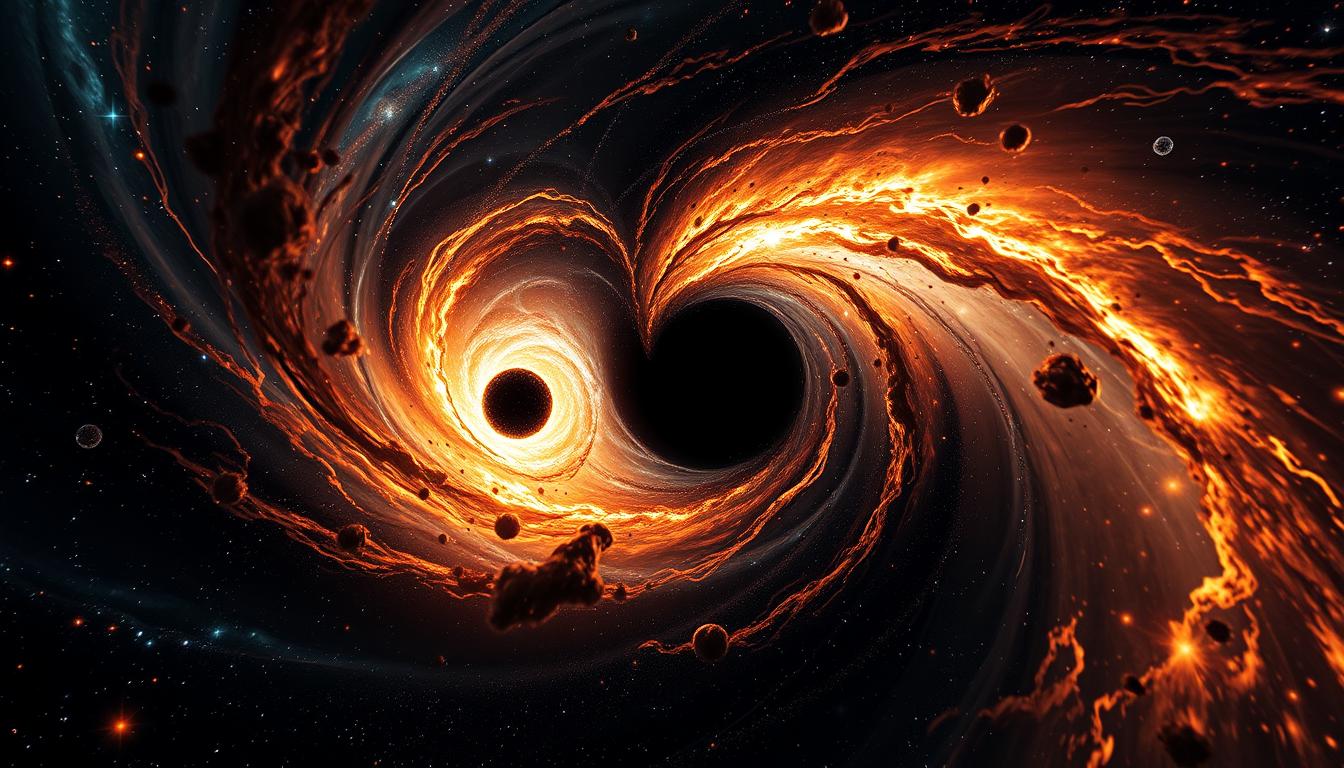
Black holes have long fascinated us. They are areas in space where gravity is so strong, not even light can escape. Recently, we’ve learned a lot more about them, thanks to new discoveries.
In 2019, scientists captured the first-ever image of a black hole. This was a huge achievement. It showed us a supermassive black hole at the center of the galaxy Messier 87, or M87. This image confirmed black holes exist and gave us a peek into their physics.
Since then, we’ve made more exciting discoveries about black holes. We’ve seen how they affect their surroundings. They create powerful energy jets and shape galaxies. We’ve also detected gravitational waves, which tell us about black hole collisions.
Black holes are more than just scientific wonders. They are key parts of our universe. By studying them, we learn about the universe’s forces and how it works.
Understanding Black Holes: The Basics
Black holes are among the most intriguing and mysterious objects in space. They form when massive stars collapse under their own gravity. This collapse creates a region with an incredibly strong gravitational pull, known as a black hole.
At the heart of a black hole is the Schwarzschild Radius. It’s a point where nothing, not even light, can escape. This area marks the boundary beyond which escape is impossible. The concept of Spacetime Curvature is key to grasping black hole physics.
“Black holes are the most extreme objects in the universe, where space and time become completely warped.” – Stephen Hawking
Black holes are known for their extreme density and how they warp Spacetime. They fascinate scientists and the public. By learning about black hole formation and structure, we gain insights into their role in the universe. This knowledge helps us understand the cosmos better.

The Role of Black Holes in the Universe
Black holes are incredible gravitational forces that shape our universe. They are at the centers of many galaxies, including our own Milky Way. These supermassive Galactic Centers have a huge impact on the universe around them.
Supermassive black holes are incredibly massive, weighing millions to billions of times more than our Sun. They act as the gravitational centers of their galaxies. Their strong pull controls the movement and growth of stars, gas, and dust in the galaxy centers.
The presence of a supermassive black hole is often connected to the creation and growth of Quasars. Quasars are the brightest objects in the universe.
“Black holes are the foundation of galaxy formation and evolution. They are truly the key to understanding the universe on the largest scales.”
As matter and energy are pulled into black holes, the area around them changes. Jets of charged particles and intense radiation are released. This activity shapes the galaxy and affects the universe’s growth.

Studying black holes helps scientists understand galaxy and universe evolution. The study of these mysterious objects fascinates scientists and the public. We are working to uncover the secrets of the universe’s heart.
Recent Discoveries in Black Hole Research
Black hole research has been thrilling, revealing new insights into these mysterious objects. A key breakthrough is our better understanding of the event horizon. This is the point of no return around a black hole, where gravity is so strong that nothing, not even light, can escape.
Scientists have managed to see the event horizon of the supermassive black hole at the Milky Way’s center. They used a global network of radio telescopes called the Event Horizon Telescope. This effort captured the first-ever image of a black hole’s event horizon, giving us a peek into its core.

Research has also focused on accretion disks, the swirling gas and dust around black holes. These disks show complex dynamics and intense radiation. They are key to black holes’ growth and evolution.
“The more we learn about black holes, the more we realize how little we truly understand about these mysterious and powerful objects.”
As scientists delve deeper, black hole research will likely reveal more about the universe and its laws. This field is full of promise for uncovering new and exciting facts.
The Physics of Black Holes
At the heart of a black hole lies a gravitational singularity. This is a point where physics as we know it fails. It’s where our understanding of the universe hits a wall. This area is incredibly curved due to a massive object collapsing in on itself.
As matter and energy get pulled towards the singularity, they face tidal forces that tear them apart. This challenges our old ways of thinking about physics. It makes us question our theories of the universe.
“Black holes are the most extreme objects in the universe, where space, time, and the very laws of physics are warped beyond recognition.”
Exploring black holes, from the event horizon to the singularity, is key. It helps us merge quantum mechanics and general relativity. These are the two main theories of modern physics. By studying black holes, we might uncover the universe’s secrets and understand spacetime better.

As we explore black holes, we face the limits of our current knowledge. We must keep pushing the boundaries of science. The quest to understand black holes continues, opening new doors to our understanding of the universe and our place in it.
The Search for Supermassive Black Holes
In our vast universe, supermassive black holes at galaxy centers are fascinating. These giants are millions or billions of times heavier than our Sun. Scientists are deeply interested in studying them.
Astronomers search for these black holes at Galactic Centers. They look at how stars and gas move. Quasars, very bright and active galaxy cores, also help in this search. They are thought to be powered by matter falling into supermassive black holes.
“The search for supermassive black holes is a thrilling pursuit, as uncovering their secrets can shed light on the formation and evolution of galaxies themselves.”
Today, scientists use advanced telescopes and technology. They track stars and gas in galaxy centers. This helps them find and learn about supermassive black holes. It also helps us understand the universe better.
The search for supermassive black holes is ongoing. Scientists are excited for new discoveries. These could help us understand these mysterious objects and their role in the universe.
Understanding Black Hole Mergers
The universe is full of amazing sights, and black hole collisions are among the most fascinating. These events, called black hole mergers, give us a peek into the universe’s nature and its growth.
Gravitational waves, predicted by Albert Einstein, are crucial for understanding black hole mergers. When two massive black holes crash, they distort spacetime, sending out gravitational waves. These waves, caught by places like the Laser Interferometer Gravitational-Wave Observatory (LIGO), tell us a lot about the event horizon.
“The detection of gravitational waves from black hole mergers has revolutionized our understanding of these enigmatic cosmic entities.”
By looking at the gravitational waves from black hole mergers, scientists learn about the colliding black holes. They find out about their mass, spin, and other features. This knowledge helps us understand how black holes shape the universe.
As we keep exploring black hole mergers, we might find many new things. The way these huge objects interact and create waves in spacetime could answer big questions about our universe.
The Mystery of Hawking Radiation
Exploring black holes, we learn about Stephen Hawking’s theory of Hawking radiation. This idea changes how we see these cosmic giants. It reveals secrets about their life cycles.
Hawking radiation is named after the famous physicist. It’s a quantum effect at a black hole’s event horizon. Hawking said that black holes actually release particles and radiation, not just pull everything in.
“Hawking radiation is a remarkable discovery that has profoundly shaped our understanding of black holes and the nature of quantum physics.”
This theory makes black holes seem more alive and changing. It shows they can evaporate and disappear. This idea was once unthinkable.
Scientists are still studying Hawking Radiation. It helps us understand black holes and the universe better. As we explore, we find new things that expand our knowledge and lead to more discoveries.
Future Directions in Black Hole Research
Our knowledge of black holes is growing, and scientists are eager for what’s next. The Event Horizon Telescope (EHT) is a key player. It’s a network of radio telescopes that has given us amazing views of a black hole at the Milky Way’s center.
Researchers want to see more of these cosmic mysteries. They hope to get clearer images of black holes. They also look forward to studying gravitational waves, which are ripples in space caused by black hole mergers.
“The future of black hole research is incredibly exciting. We’re on the cusp of major breakthroughs that could fundamentally change our understanding of these enigmatic phenomena.”
Gravitational wave detectors are getting better. Soon, scientists will see black hole mergers in great detail. This will help them understand these violent events better. By using both the EHT and gravitational waves, they aim to uncover black hole secrets.
The future of black hole research is full of possibilities. Scientists might learn more about how black holes warp space and time. They could also discover what happens at the center of a black hole. The journey ahead promises to reveal more about these cosmic wonders.
Black Holes in Popular Culture
Black holes have always fascinated people, leading to many science fiction stories and movies. Works like “Interstellar” by Kip Thorne and its film adaptation have made black holes a key part of science fiction. They draw us in with their mystery and grandeur.
These stories have shaped how we see black holes, mixing science with fiction. The images of black holes, with their spinning edges and distorted space, excite our curiosity. They make us wonder about the unknown.
As we learn more about black holes, the mix of science and culture will grow. The search for supermassive black holes and studying Hawking radiation will inspire new stories. These tales will bring the universe’s wonders to our attention.